
How to Recognize When Someone Is in Crisis: Reading the Warning Signs

How to Recognize When Someone Is in Crisis: Reading the Warning Signs
A GUIDE TO RECOGNIZING THE RISK CURVE
Every human being communicates not only through words, but through posture, breath, movement, and silence. When a person is in distress, their body and behavior often speak far louder than their voice. Learning to read these signals is not a clinical skill reserved for professionals. It is a deeply human one, available to anyone willing to pay attention.
Understanding behavior as communication may be the most important thing you can do for someone in crisis whether they are a family member, a colleague, or a stranger on the street.
Distress does not arrive fully formed. It follows a curve a progression from the earliest flickers of anxiety through defensiveness and, if left unaddressed, toward the possibility of harm.
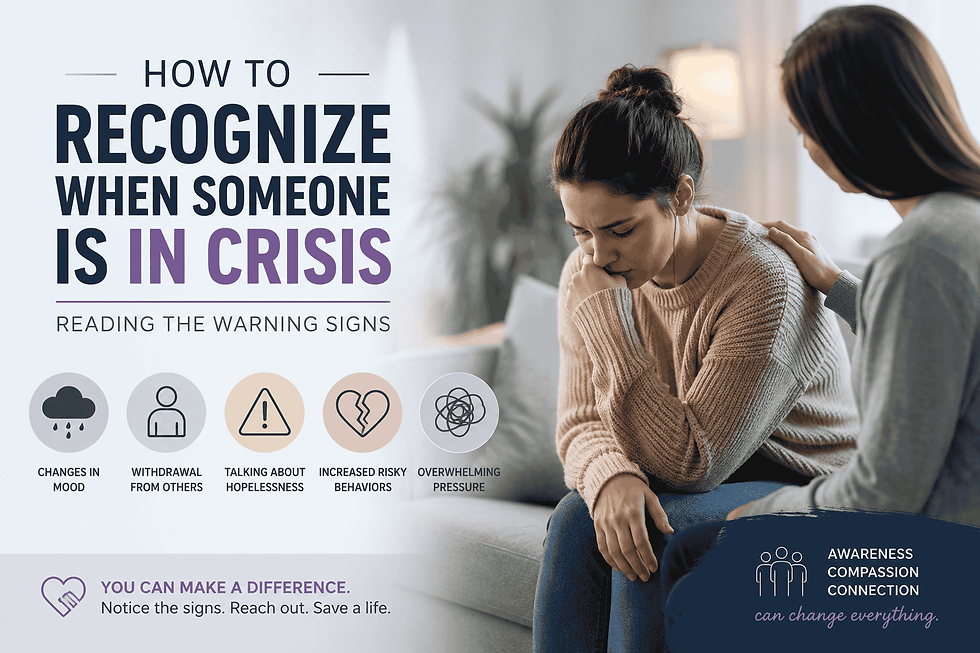
Each stage carries its own signals. Each stage also carries its own opportunities for intervention. The earlier you recognize where someone sits on this curve, the more options you have and the more difference you can make.
The Distress Risk Curve
LOW Anxiety | MEDIUM Defensiveness | HIGH Escalation | EXTREME Harm |
"Behavior is the language of the overwhelmed. When someone cannot say 'I am not okay,' their body finds another way to say it."
Stage One
● Low Risk
Anxiety: The First Signal
Anxiety is the body's early warning system a physiological and psychological response to perceived threat, uncertainty, or overwhelm. At this stage, a person has not lost control. They are struggling to maintain it. This is the most critical window for compassionate intervention, because the person is still accessible, still reasonable, and still open to support.
Anxiety at this stage is rarely dramatic. It is easy to miss, easy to dismiss, or easy to mistake for ordinary stress. That is precisely why it matters to know its signals.
Common Signals of Anxiety
Restlessness inability to sit still or settle
Shallow, rapid, or irregular breathing
Fidgeting, hand-wringing, or repetitive self-touching
Avoidance of eye contact or over-sustained eye contact
A voice that becomes quieter, faster, or slightly higher in pitch
Distractibility difficulty tracking conversation
Excessive apologizing or social withdrawal
Physical tension: jaw clenching, shoulder rigidity, furrowed brow
Uncharacteristic silence or sudden over-talking
Pallor or flushing of the skin
At the anxiety stage, the nervous system is engaged but not yet flooded. The person may appear merely "off" quieter than usual, distracted, or slightly on edge. They may not even recognize the depth of their own distress. This is where early, gentle acknowledgment can redirect the entire trajectory.
Someone You Know
| A Stranger
|
Stage Two
●● Medium-High Risk
Defensiveness: When Walls Go Up
If anxiety is not recognized or addressed, the distress escalates. The nervous system, receiving no relief, moves into a more protective mode. What was internal tension now begins to turn outward not necessarily as aggression, but as defense. The person is communicating, even more urgently, that they feel unsafe, unheard, or cornered.
Defensiveness is the body building a wall. It is important to understand that this wall is not directed at you it is protection against whatever pain or threat the person perceives. Responding with counter-defensiveness at this stage will almost certainly accelerate the escalation.
Common Signals of Defensiveness
Crossed arms, turned shoulders, or physically closed posture
Raising of the voice or sharp, clipped speech
Denial or minimization: "I'm fine, leave me alone"
Irritability disproportionate to the situation
Blaming others or externalizing all responsibility
Pacing, inability to stay in one place
Sarcasm, dismissiveness, or contemptuous language
Challenging statements or testing boundaries
Difficulty accepting any form of help or reassurance
Increased agitation when approached or questioned
The key insight at this stage: the person is not being difficult they are struggling to cope. Their nervous system has been running hot for too long. They may be embarrassed, frightened, or deeply overwhelmed. The goal of any response is to reduce the perceived threat, not to win an argument or enforce compliance.
Someone You Know
| A Stranger
|
Stage Three
●●●● Extreme Risk
Harm: The Crisis Point
When distress has escalated through anxiety and defensiveness without resolution, the risk of harm to the self or to others becomes real. This does not mean that harm is inevitable. Even at this stage, the right response can interrupt the trajectory. But the stakes are now acute, the window for intervention is narrow, and your own safety must be a priority.
Harm at this stage may be turned inward self-harm, suicidal ideation, or complete emotional collapse or outward, as physical aggression or threatening behavior. The signals are usually unmistakable, but they can still be misread as "drama" or dismissed by bystanders who do not want to intervene. That hesitation can be the difference between life and death.
Signals of Imminent Harm Self-Directed
Statements of hopelessness or worthlessness
Talking about being a burden to others
Giving away prized possessions
Sudden calm after a period of extreme distress (a serious warning sign)
Explicit or veiled statements about not wanting to be alive
Seeking access to means of self-harm
Social withdrawal and saying goodbye to people
Signals of Imminent Harm Other-Directed
Explicit threats to specific individuals
Physical aggression pushing, striking, throwing objects
Extreme agitation with loss of rational communication
Fixation on a grievance that has intensified over time
Seeking weapons or discussing violence in concrete terms
A sudden, eerie calm following agitation (emotional shutdown)
Eyes that are unfocused, glassy, or dissociated
"A sudden calm after the storm is not resolution. It is often the most dangerous moment when the decision has been made."
Someone You Know
| A Stranger
|
Why This Knowledge Matters
The distress risk curve is not a clinical abstraction. It plays out in homes, offices, parks, and shopping centers every day, often invisibly. Most people in crisis never receive help because no one around them knew what to look for or felt confident enough to act.
Understanding behavior as communication does not require a degree in psychology. It requires attention, compassion, and the willingness to take someone's signals seriously before those signals become a crisis. The earlier you recognize the curve, the more options you have: a quiet word, a gentle presence, a hand extended at the right moment.
Equally important is knowing your limits. You are not a therapist, a police officer, or a crisis counselor. Your role whether the person is someone you love or a stranger on the street is to recognize what you are seeing, respond in the safest, most humane way you can, and call on the right resources when the situation requires it. Being willing to make that call, without hesitation, is itself an act of profound care.
Behavior speaks. The question is whether any of us are listening.

About the Author: William DeMuth is the Director of Training at the Center for Violence Prevention and Self Defense (CVPSD) in Freehold, NJ. With over 35 years of research in violence dynamics and personal safety, William specializes in evidence-based training that bridges the gap between compliance and real-world conflict resolution. The architect of the ConflictIQ™ program, he holds advanced certifications and has trained under diverse industry leaders. Today, he actively trains civilians, healthcare workers, and corporate teams in situational awareness, threat assessment, behavior analysis, de-escalation strategies, and physical tactics.


